Who’s Calling? BatchData’s New Reverse Skip Trace API Turns an Unknown Number Into a Person — and the Property They Own
BatchData's Reverse Skip Trace API resolves a phone number or email into a person and their linked property in one call
Press Release Disclaimer: This is a press release distributed through the XPR Media network. It has not been independently verified by our newsroom.
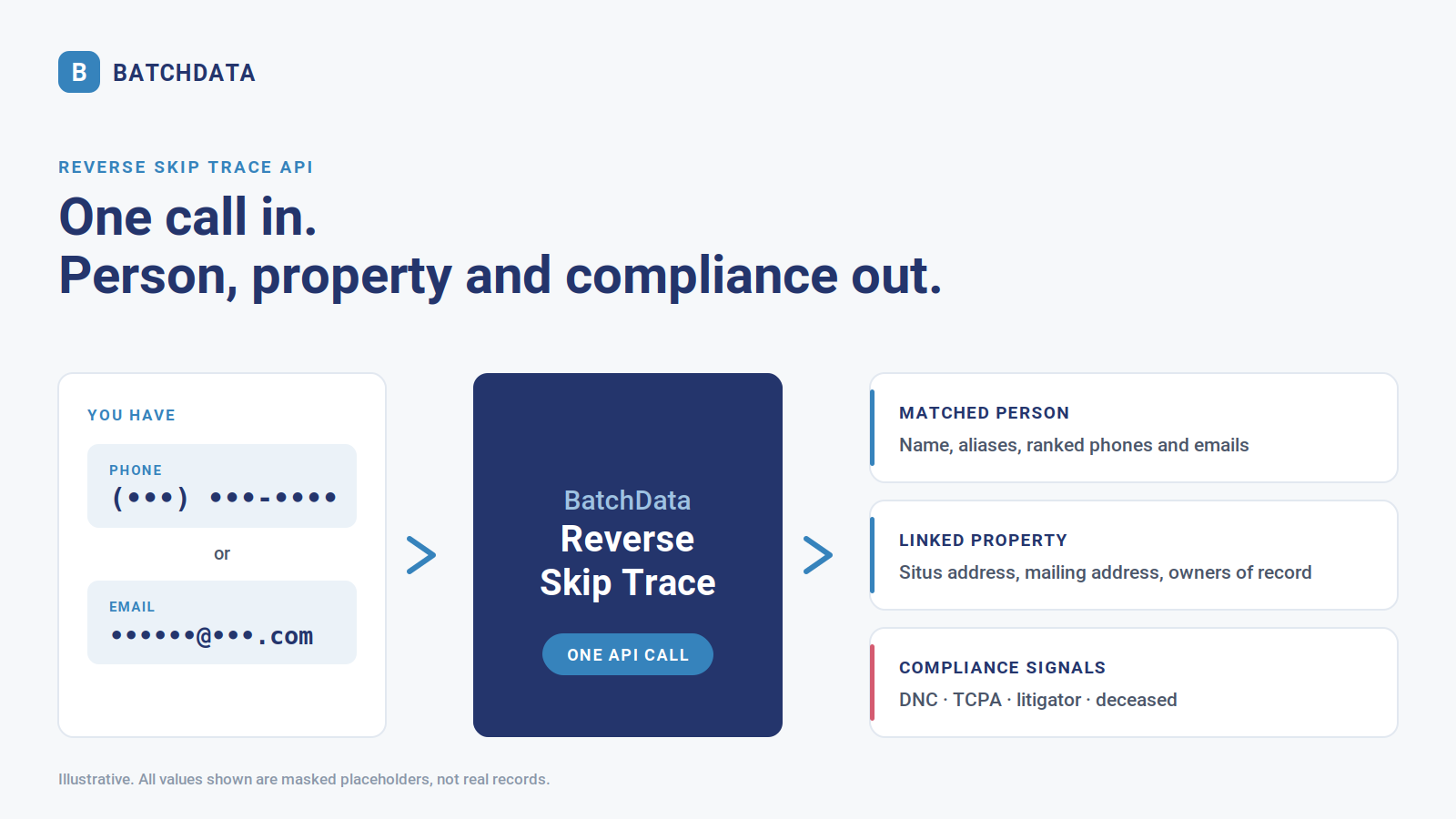

BatchData’s Reverse Skip Trace API resolves a phone number or email into a person and their linked property in one call
TEMPE, AZ, AZ, UNITED STATES, August 26, 2026 /EINPresswire.com/ — The phone rings. The number isn’t in the CRM. Somebody has about ten seconds to decide whether this is a motivated seller, a policyholder, a loan applicant, or a wrong number — and most teams make that call blind, or don’t make it until someone has run a manual lookup and the moment has passed.
BatchData has announced general availability of its Reverse Skip Trace API, which answers the question directly. Hand it a phone number or an email address and it gives back the person behind it — their name and aliases, their other reachable phones and emails, and the property linked to them — in a single call.
Skip Tracing, Run in Reverse
Standard skip tracing — the same process industries outside real estate usually call contact enrichment — starts with a name or a property address and finds contact details. Reverse Skip Trace, or reverse contact enrichment, runs the other way: it starts where most teams actually start, with the contact information already sitting in the CRM, on the inbound call, or in the lead form.
The dual naming is deliberate. “Skip tracing” is native vocabulary in real estate and recovery work and close to meaningless in insurance, lending or home services, so BatchData describes the same capability as reverse contact enrichment when it talks to those teams. The API call is identical. Only the word for it changes.
“For years the job was ‘here’s a name and an address, go find me a phone number,'” said Ivo Draginov, President and co-founder of BatchData. “A huge share of our customers now start from the opposite end. They have the number. What they don’t have is any idea who’s attached to it, or whether that person owns anything worth talking about. That’s the question we built this to answer.”
The result is a reverse phone lookup API that returns property context alongside the person. Feed it a phone number, an email, or both together for a stronger match — one at a time, or up to 100 inputs per call. A name isn’t an input; that’s what forward skip tracing is for.
One number can legitimately belong to more than one person — households, shared lines, reassigned numbers. BatchData returns the top matches it finds, up to three per lookup, ranked by match strength.
What Comes Back
Each matched person arrives as one structured record:
Identity — full name, first, middle and last, AKA aliases, date of birth where available, and an owner-of-record flag
Phone intelligence — additional numbers, ranked, each with line type, carrier and reachability signals
Email records — addresses, ranked, with deliverability testing
Addresses — street, city, state, ZIP, ZIP+4, county, and address validity
Linked property — the property currently linked to that person: property ID, situs address, mailing address where it differs, and owners of record
Compliance signals — DNC and TCPA flags on each number, plus litigator and deceased indicators on the person
It all arrives together, in one response, with no add-on charge for the compliance signals.
Pairing identity resolution with property data in a single response is the part BatchData considers the real engineering.
“Reverse lookup on its own isn’t especially hard,” said Charles Parra, Chief Data Officer at BatchData. “Holding an identity graph and a property graph in the same system, and walking cleanly from one to the other, is. We already had both sides. Connecting them was the build.”
Compliance Signals Ship With the Record
Teams that dial or email at volume work inside TCPA, Do Not Call and state calling rules. The usual pattern is to enrich first and scrub second, often through a second vendor, sometimes after a complaint has already landed.
Reverse Skip Trace returns the signals inline: a Do Not Call flag against the national registry on each number, a TCPA flag on each number, and litigator and deceased indicators on the person. Suppression happens before an agent hits dial rather than after.
BatchData is precise about what those signals are. They are inputs to a customer’s compliance process, not a replacement for one. Consent, internal suppression lists, state registries and calling-hour rules stay with the customer, and BatchData does not represent that any number is cleared to call.
The Number BatchData Won’t Publish
Ask a data vendor for a match rate and you’ll usually get one. BatchData declines to publish a figure for this endpoint, on purpose.
“How well this performs depends far more on where a customer’s contact data came from than on anything we do,” Draginov said. “A number captured on a live inbound call and a number scraped off a form fill three years ago are not the same input. Publishing a single average would be telling most customers something untrue about their own file. We’d rather run their data and show them the real number.”
The same discipline applies elsewhere in how the product is described. The property returned is the one currently linked to that person, not a list of everything they have ever owned. The deceased and litigator flags are indicators, not certified suppression files.
Built for Teams Whose Day Starts With an Unknown Contact
Real estate investing. For wholesalers, fix-and-flip operators and dispositions teams, an unknown inbound number is a lead nobody has qualified yet. Acquisitions reps open every call already knowing which property the caller is linked to, so qualification happens during the call instead of after it — and cold-calling and dialer operations get the same picture before the first ring.
Proptech platforms. Product teams building lead-generation, CRM or investor tools get identity and property back from one call, instead of integrating an identity vendor and a property vendor separately and maintaining the join between them.
Insurance. Match an inbound phone or email to the policyholder or claimant behind it, see the property linked to them, and catch detail that doesn’t agree with the file.
Lending and mortgage. Turn an inbound loan inquiry into the person behind it and their linked property, so the team can pick up the conversation without chasing down basic contact details.
Home services, solar and roofing. Turn lists of bare phone numbers into homeowner records with property linkage, so reps spend the day on roofs whose owners they can actually reach, and dispatchers quote and route without the back-and-forth.
Call centers. Screen inbound contacts against DNC and TCPA flags before a rep responds, and confirm the caller is who the campaign meant to reach.
Data and CRM teams. Run existing records through reverse contact enrichment to fold in newly found phone and email aliases and retire mis-attributed entries.
You Only Pay for the People We Find
Usage is metered by matched person records returned, not by API calls sent. A lookup that finds nobody isn’t billed at all. A lookup that resolves to a household of three bills as three, because that’s three identities delivered.
“If we don’t find anyone, you shouldn’t pay for looking,” Draginov said. “This product exists for probing contacts of unknown quality. A per-call meter punishes you for doing the exact thing it’s built for.”
Published plans run from Growth at $3,000 per month for up to 100,000 matched records, through Professional at $7,500 for 300,000, Scale at $15,000 for 750,000, and Enterprise at $30,000 for 3,000,000. Pay-as-you-go is available for teams that want to measure their own volume first, and records past a monthly allotment bill at the plan’s own per-record rate rather than a penalty tier. Current details are at batchdata.io/pricing.
Two Ways In, One With No Code
Reverse Skip Trace is a RESTful JSON API with synchronous and asynchronous endpoints, documented at developer.batchdata.com. It runs on the same BatchData account and credentials customers already use for property data, contact enrichment and standard skip tracing.
For teams without developer capacity, the same capability ships as tools on the BatchData MCP Server, so an AI assistant can run reverse lookups in natural language with nothing to integrate. Bulk delivery — custom extracts over SFTP in CSV, JSON or Parquet — and managed match-and-append services are also available.
Availability
The Reverse Skip Trace API is generally available now to BatchData customers in the United States, including the proptech platforms, real estate investment operations, insurers, lenders and home services businesses already building on BatchData’s property data. Teams evaluating it can send a sample file of phone numbers or email addresses and get results back against their own data. Full field-level documentation, use cases and pricing are at https://batchdata.io/reverse-skip-trace-api.
Important Use Limitations
BatchData is not a consumer reporting agency, and the output of the Reverse Skip Trace API is not a consumer report. It may not be used, in whole or in part, as a factor in establishing an individual’s eligibility for credit, insurance, employment, housing, or for any other purpose covered by the Fair Credit Reporting Act, including pre-qualification. Customers are responsible for determining that their intended use complies with all applicable federal and state law.
About BatchData
Founded in 2018, BatchData is a leading provider of property data and predictive intelligence for the real estate ecosystem. Built by industry experts, BatchData has established one of the deepest and most accurate data lakes in the property technology sector, delivering instant access to over 155 million U.S. property records. The platform empowers businesses — ranging from proptech startups to enterprise institutions — with robust APIs, bulk data solutions, and AI-powered insights. By transforming complex public records into actionable intelligence, BatchData fuels decision-making for investors, lenders, and home service providers nationwide. For more information, visit www.BatchData.io
Ivo Draginov
BatchData
+1 602-399-4250
email us here
Visit us on social media:
LinkedIn
Legal Disclaimer:
EIN Presswire provides this news content “as is” without warranty of any kind. We do not accept any responsibility or liability
for the accuracy, content, images, videos, licenses, completeness, legality, or reliability of the information contained in this
article. If you have any complaints or copyright issues related to this article, kindly contact the author above.

Media gallery