Blood Cancer Treatment Advances Have Saved Nearly 26 Million Years of Life Over Past 75 Years
WASHINGTON, Sept. 1, 2026
Press Release Disclaimer: This is a press release distributed through the XPR Media network. It has not been independently verified by our newsroom.

Blood Cancer Treatment Advances Have Saved Nearly 26 Million Years of Life Over Past 75 Years
PR Newswire
WASHINGTON, Sept. 1, 2026
New analysis introduces a life-years saved methodology to track how research funding, health care policy and access to treatment translate into more time for patients
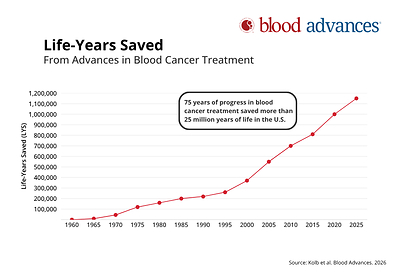
WASHINGTON, Sept. 1, 2026 /PRNewswire/ — A new analysis published today in Blood Advances introduces a novel “life-years saved” methodology that, for the first time, quantifies the impact of blood cancer treatment advances over the past 75 years, starting when the first chemotherapies emerged. The methodology translates decades of scientific progress into something universally meaningful: more time.
The research led by Blood Cancer United is a retrospective analysis to examine progress from 1949, when the first blood cancer chemotherapies emerged, through 2024. The analysis found that advances in therapies for leukemia, lymphoma, myeloma and other blood cancers have resulted in an estimated 25.8 million life-years saved in the United States over the past 75 years. Using data from the National Cancer Institute’s Surveillance, Epidemiology and End Results (SEER) Program, and integrating cancer incidence, mortality and U.S. life expectancy, the life-years saved methodology calculates the amount of life restored because of therapeutic innovation.
Blood cancers account for nearly 10% of all cancer diagnoses in the United States, and incidence has continued to rise over time, with more than 192,000 new cases expected this year. Unlike many solid tumor cancers where prevention and screening drive improved survival, progress against blood cancers depends almost entirely on therapeutic innovation and access to treatment.
“As blood cancer incidence continues to rise and more patients depend on ongoing or lifelong treatment for survival, traditional measures such as five-year survival rates and mortality rates do not capture the full story of progress against blood cancer,” says E. Anders Kolb, M.D., president and CEO at Blood Cancer United. “Life-years saved – the number of additional years of life gained because of treatment advances – provides a more meaningful way to monitor progress over time and assess how changes in healthcare policy, research funding and access to treatment may impact patients’ lives.”
Life-years saved gives researchers, advocates and policymakers a new way to measure whether scientific advances and access to care are translating into more time for blood cancer patients. This comes at a critical time as remarkable scientific advances over the past few decades have led to life-saving therapies, but continued progress depends on sustained research funding, faster development of promising treatments, clinical trial participation, improving access to care, and healthcare policies that help patients navigate and afford care.
The analysis also highlights significant gaps across diseases and racial groups. Survival progress remains limited for people diagnosed with acute myeloid leukemia (AML) and across most major blood cancer types among Black individuals.
“This new methodology gives us a clear, intuitive way to measure progress, and to see where we must accelerate it,” says co-author Ann-Kathrin Eisfeld, M.D., a hematologic oncologist at The Ohio State University Comprehensive Cancer Center – Arthur G. James Cancer Hospital and Richard J. Solove Research Institute (OSUCCC – James). “While millions of life-years have been gained, the data show stark gaps, particularly for Black patients and those with acute myeloid leukemia. Continued investment in research and equitable access to advanced therapies are essential to ensuring all patients benefit from scientific progress. Now we will be able to track progress, or the lack thereof, moving forward, to be able to provide feedback for critical need areas—and required investments.”
Key Findings
Nearly 26 million life years saved, with future progress dependent on investment in research and treatment access
- Researchers estimate that blood cancer treatments have saved 25.8 million life-years from 1949 through 2024.
- On the current trajectory, blood cancer therapies are expected to add 18.9 million life-years from 2026 to 2040, but that projection is not a target or guarantee. Health policy changes that limit coverage, create barriers to care, or limit access to effective treatments could significantly slow progress.
- Accelerating scientific innovation and expanding access to care could accelerate the trajectory by 1 million additional life-years by 2040 (with an estimated range of 0.8 million to 1.5 million) beyond what would otherwise be achieved. This is the opportunity Blood Cancer United is working to realize through its Bold Goal.
- Early gains in life‑years saved were driven by cytotoxic therapy, radiation and transplantation. Progress accelerated with the introduction of monoclonal antibodies, kinase inhibitors, and other targeted therapies.
- Future progress will rely on innovative combinations, precision medicines and next-generation immunotherapies, including bispecific antibodies, antibody-drug conjugates, and cellular therapies.
Progress varies significantly by cancer type
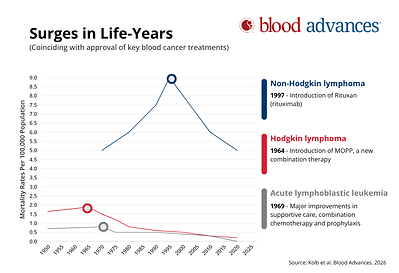
- Substantial improvement in Hodgkin lymphoma and acute lymphoblastic leukemia treatment began decades ago, leading to the largest cumulative life-years saved to this point (about 32% of the total life-years saved is for Hodgkin lymphoma and 25% for acute lymphoblastic leukemia).
- Non-Hodgkin lymphoma accounts for about 21% of all life-years saved, driven by more recent advances in immunotherapies such as rituximab (approved in 1997) and the large incidence of non-Hodgkin lymphoma.
- Acute myeloid leukemia shows the smallest gains, especially among older adults, pointing to the need for new first-in-class therapies.
Racial disparities persist
- Black patients experience significantly worse survival than White patients across most blood cancers.
- Multiple myeloma is a notable exception, with equitable or better outcomes for Black patients when access to treatment is comparable.
Path Forward
According to the authors, increasing life-years saved will require:
- Sustained research investment across federal, nonprofit and industry sectors
- Broader access to advanced therapies and effective treatments
- Faster development of first-in-class drugs, especially for acute myeloid leukemia and other myeloid cancers
- Targeted efforts to close racial and age-based survival disparities
These priorities align with Blood Cancer United’s Bold Goal to enable people with blood cancer to gain more than 1 million years of life by 2040, beyond what would otherwise be achieved. Reaching that goal will require continued investment in research, faster therapeutic innovation and broader, more equitable access to effective treatments.
Blood Cancer United plans to develop an annual report to measure progress across blood cancers and toward its Bold Goal.
“The past 75 years prove that when we invest in scientific discovery, we give patients more time,” says Dr. Kolb. “Every year of life matters, and millions more are within reach if we sustain research funding, accelerate the next generation of breakthroughs and ensure better access to treatment for everyone.”
Study Contributors: This analysis was developed and conducted by researchers from Blood Cancer United and The Ohio State University Comprehensive Cancer Center – Arthur G. James Cancer Hospital and Richard J. Solove Research Institute (OSUCCC – James) in conjunction with Lumanity.
About Blood Cancer United®
Blood Cancer United® (formerly The Leukemia & Lymphoma Society) is the largest global nonprofit focused on blood cancer patient support, research, and advocacy. Since their founding in 1949, the organization has consistently evolved to better serve people affected by all 100-plus types of blood cancer. Blood Cancer United funds innovative research, offers free resources and personalized support, and advocates at state and national levels for more accessible and affordable healthcare for all patients. To learn more, visit www.BloodCancerUnited.org.
About Lumanity
Lumanity is a leading global strategic partner for biopharmaceutical companies, engineering breakthrough value to transform lives. We combine deep scientific, clinical, medical, regulatory, and commercial expertise with advanced technology and AI-driven tools to guide decisions and execution across the entire medicine value creation journey. With 1,200 experts conducting work in over 50 countries, we serve leading pharmaceutical and biotech companies worldwide, integrating strategy, evidence, engagement, and technology to accelerate and optimize access to life-changing medicines.
Media Contact
Sandra Salviejo
Senior Director, Communications, Blood Cancer United
Sandra.salviejo@bloodcancerunited.org
 View original content to download multimedia:https://www.prnewswire.com/news-releases/blood-cancer-treatment-advances-have-saved-nearly-26-million-years-of-life-over-past-75-years-302866275.html
SOURCE Blood Cancer United® formerly The Leukemia & Lymphoma Society