
Two-Year Analysis of 25 Schools Identifies the Exact Math Concepts Where Students Stall
ClassGaga research brief examines 428,082 student and concept records across 1,574 math concepts and finds strong
Press Release Disclaimer: This is a press release distributed through the XPR Media network. It has not been independently verified by our newsroom.
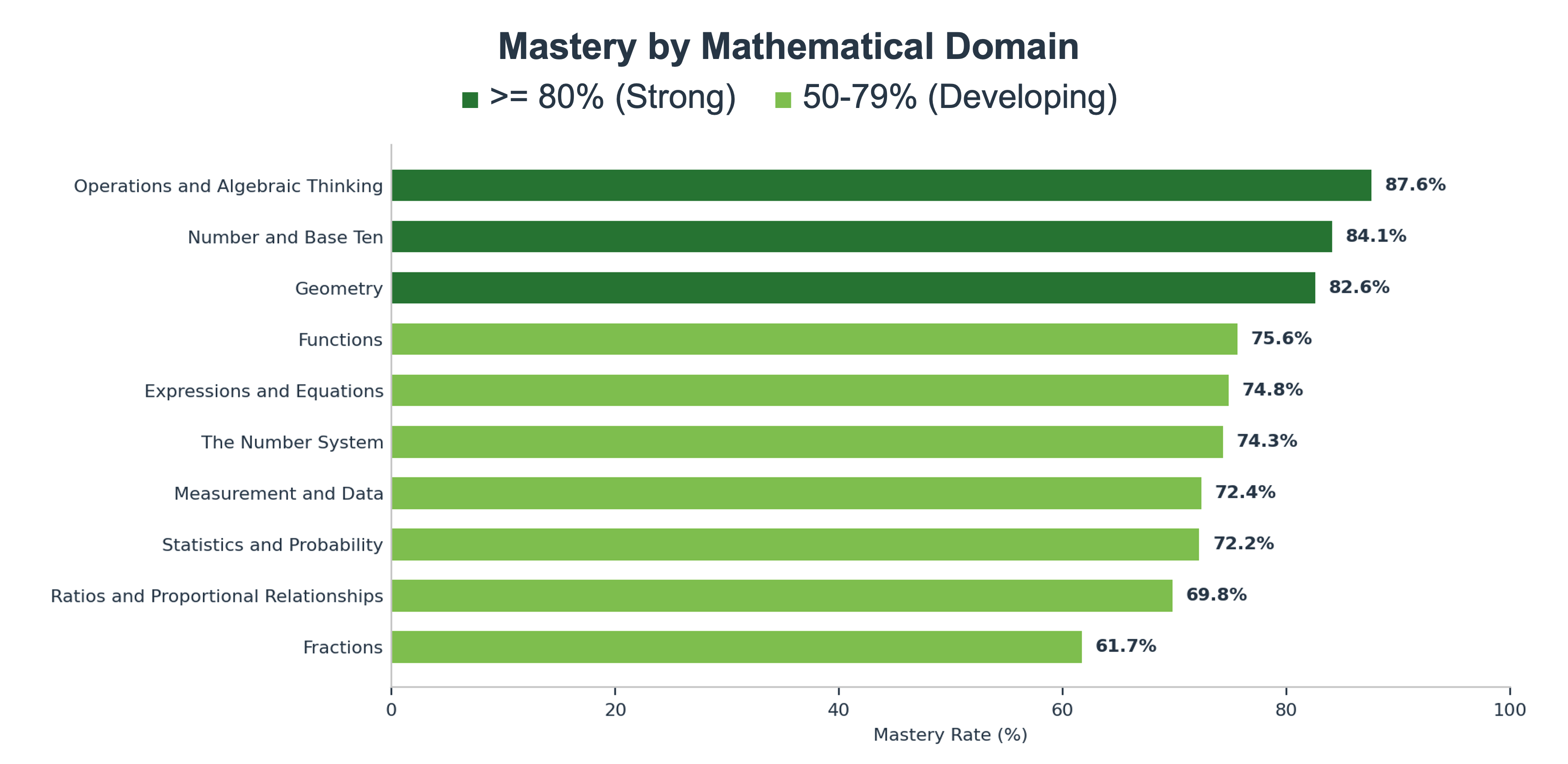

ClassGaga research brief examines 428,082 student and concept records across 1,574 math concepts and finds strong foundational arithmetic and gaps.
PRINCETON, NJ, UNITED STATES, September 18, 2026 /EINPresswire.com/ — Students across 25 schools mastered foundational arithmetic at consistently high rates, while a specific and repeatable set of concepts led by fractions and applied problem solving emerged as the clearest targets for instruction, according to a research brief released today by ClassGaga.
The brief, Multi-School Math Learning Analysis, draws on 428,082 student and concept records from 4,405 students working across 1,574 individual math concepts between August 1, 2024 and June 30, 2026. Overall recorded mastery was 81.8%.
ClassGaga measures mastery at the level of the individual concept rather than at the level of a test score or a subject average. Each record represents one student’s standing on one concept, counted as mastered at a recorded value of at least 80%, and every domain and content-level rate is weighted by the full body of records behind it. Because the program adapts to each learner, content labels describe the level of the material a student is working on, which allows the analysis to report cleanly on Grade 1 through Grade 8 content across ten standards-aligned mathematical domains.
The resolution this produces is the point. A subject average of 84% can contain one concept at 98% and another at 17%. Only concept-level reporting separates the two, and only that separation tells a teacher what to do on Monday.
Key Findings
1. Foundational domains were strongest. Operations and algebraic thinking reached 87.6% mastery, number and base ten 84.1%, and geometry 82.6%.
2. Fractions were the clearest area for instructional focus at 61.7%. Comparing, converting, multiplying, and dividing fractions each contained concepts of concern, and fraction work appeared among the priority needs at every content level from Grade 3 through Grade 7.
3. Grade 4 and Grade 5 content concentrated the difficulty, at 71.2% and 64.1%. Grade 1 content was the strongest level at 90.1%.
4. Subject averages can mask a specific difficulty. Within number and base ten, identifying place values in Grade 4 content reached 98% mastery while finding missing digits in Grade 2 subtraction reached 17.2%.
5. Middle school averages held while specific applications lagged. Grade 7 content averaged 76.9%, yet word problems with rational numbers sat at 13.6% and proportion word problems at 24.9%.
Four Instructional Priorities Recurred at Every Content Level
– Fractions, from representation to operation. Students succeeded with fraction pictures and bars well before they could rewrite an equivalent quantity or decide which operation a situation called for.
– Choosing a method before calculating. Guess and check problems, compensation, estimation, proportions, and systems word problems each require a decision before any computation, and each showed low mastery.
– Connecting equivalent forms. Place value conversion, improper fractions and mixed numbers, equivalent expressions, and writing a linear function from a table all ask students to recognize the same quantity in another form.
– Interpreting an answer in context. Interpreting a remainder (18.7% at Grade 5 content), reading the effect of an outlier (37.6% at Grade 6 content), and rational-number word problems were consistently weaker than the procedures behind them.
The Same Patterns Appeared in Two Independent Analyses
ClassGaga’s September 2025 research brief, drawn from a different group of school sites and a different analytic window, identified missing-digit subtraction, interpreting remainders, fraction division word problems, and finding an original amount after a percent change as concepts with low mastery. All four remain areas of concern in the 2026 records. Operations and algebraic thinking ranked as a leading strength in both analyses, at 86.9% and 87.6%, and Grade 4 and Grade 5 content formed the lowest part of the content-level profile in both.
Replication of this kind is what elevates a finding from a local result to a durable instructional target. The concepts identified here are not artifacts of one school year or one group of schools.
Why It Matters for Schools
The brief points toward explicit classroom attention to choosing a method, connecting different representations, and interpreting an answer in context, supported by worked examples that make those decisions visible. Teachers and administrators in participating schools see the same concept-level detail in real time through Insight360, which turns each of these findings into a class list of students who need a specific skill.
The full research brief is available at ClassGaga Impact.
Results represent performance on the ClassGaga platform during the study window and do not represent the overall ability level of all students at participating schools.
Karen Sun
ClassGaga
email us here
Visit us on social media:
LinkedIn
Instagram
Facebook
YouTube
TikTok
X
Legal Disclaimer:
EIN Presswire provides this news content “as is” without warranty of any kind. We do not accept any responsibility or liability
for the accuracy, content, images, videos, licenses, completeness, legality, or reliability of the information contained in this
article. If you have any complaints or copyright issues related to this article, kindly contact the author above.

Media gallery


