
Vadzo Imaging Launches Armor-2020MRS-GMSL2: 20MP Monochrome GMSL2 Camera for High Detail Imaging in Industrial Inspection Systems
The Armor-2020MRS-GMSL2 is a 20MP Monochrome GMSL2 Camera, and Vadzo Imaging is launching it for great detail imaging
Press Release Disclaimer: This is a press release distributed through the XPR Media network. It has not been independently verified by our newsroom.


The Armor-2020MRS-GMSL2 is a 20MP Monochrome GMSL2 Camera, and Vadzo Imaging is launching it for great detail imaging in industrial inspection systems. Inspection asks a camera to resolve small features, read characters and codes, and do it again on every part, shift after shift, often from a position far from the computer. A monochrome sensor with no color filter collects more light per pixel and needs no color interpolation, so edges stay sharp, and 5120 x 3840 pixels put plenty of them on a defect. A GMSL2 link carries the video over coaxial cable, with control and power on the same cable. The Armor-2020MRS-GMSL2 adds near-infrared response, low-latency streaming, multi-camera readiness, and a rugged build. As a 20MP Mono GMSL2 Camera and an AR2020 Monochrome GMSL2 Camera, it supplies clean grayscale frames to inspection software.
FORT WORTH, TX / ACCESS Newswire / November 18, 2026 / Vadzo Imaging, a provider of embedded vision camera products for OEMs and system integrators, today launches the Armor-2020MRS-GMSL2, a 20MP Monochrome GMSL2 Camera built on the Onsemi AR2020 sensor. Part of Vadzo’s SerDes camera portfolio, it combines 20MP monochrome resolution, low light sensitivity, near infrared response, and a GMSL2 interface with a single cable design and multi camera readiness. Vadzo presents an AR2020 Monochrome GMSL2 Camera and a 20MP Mono GMSL2 Camera for inspection, robotics, and surveillance systems.
Why a 20MP Monochrome GMSL2 Camera Suits High-Detail Inspection
Inspection is a measurement task, and measurement is limited by pixels, light, and timing. A defect that spans only one or two pixels is easily lost in noise, a character that spans too few cannot be read, and a part that moves during the exposure smears across several pixels. Resolution helps with the first two, and a color sensor works against them, because its filter array passes only part of the light to each pixel and its interpolation softens fine edges.
Distance and cabling complicate the installation. Inspection stations sit on lines, gantries, and moving cells, while the computers sit in cabinets, and the cable between them must carry a large stream, tolerate vibration, and keep electrical noise out of the image. Several stations on one line often need to work together. A serial link such as GMSL2 answers these needs, and a design still has to match the stream to the link and the exposure to the speed of the line.
How a 20MP Monochrome GMSL2 Camera Resolves Fine Detail Over One Cable
The Armor-2020MRS-GMSL2 is built on the Onsemi AR2020, a 20MP (5120 x 3840) monochrome rolling shutter sensor with a 1/1.8 inch optical format and 1.4 micron pixels, in the Hyperlux LP back-illuminated design. With no color filter array, more light reaches each pixel, and every pixel is a real measurement. A short calculation shows what 20MP offers an inspection station. If the camera views a field 150 millimeters wide across 5120 pixels, each pixel covers about 29 microns. A defect 0.1 millimeter wide then spans about 3.4 pixels, a character 1.5 millimeters tall spans about 51 pixels, and a barcode bar 0.25 millimeter wide spans about 8.5 pixels, all comfortably above the few pixels that most software needs.
The data rate is the monochrome advantage on a serial link. A full frame at 8 bits per pixel is about 157 million bits, so 30 frames per second needs about 4.7 gigabits per second, which fits within the nominal forward rate of up to 6 gigabits per second of one GMSL2 link, before overhead. A 10-bit output at the same rate would need about 5.9 gigabits per second and leave little margin. The figures are illustrative, and teams should confirm the available modes and formats. Timing is the other limit. On a conveyor moving at 0.5 meters per second, a 1 millisecond exposure moves the part 0.5 millimeters, which is about 17 pixels, so inspection with a rolling shutter sensor normally uses strobe lighting with an exposure of tens of microseconds, which freezes the motion.
GMSL2, the second generation of the Gigabit Multimedia Serial Link, carries video on a forward channel and control on a slower reverse channel over coaxial cable or shielded twisted pair. In the single-cable design, video, control data, and power share one coaxial cable, and a long run drops voltage in proportion to the current, so the power budget should be checked. A multi-port deserializer can accept several camera links for synchronized capture across stations. Near infrared response suits illumination that is invisible to workers, and teams should confirm the response at the wavelengths of their illuminators. Teams should also confirm the latency of the whole chain, since the sensor readout and the host processing usually add more than the serial link.
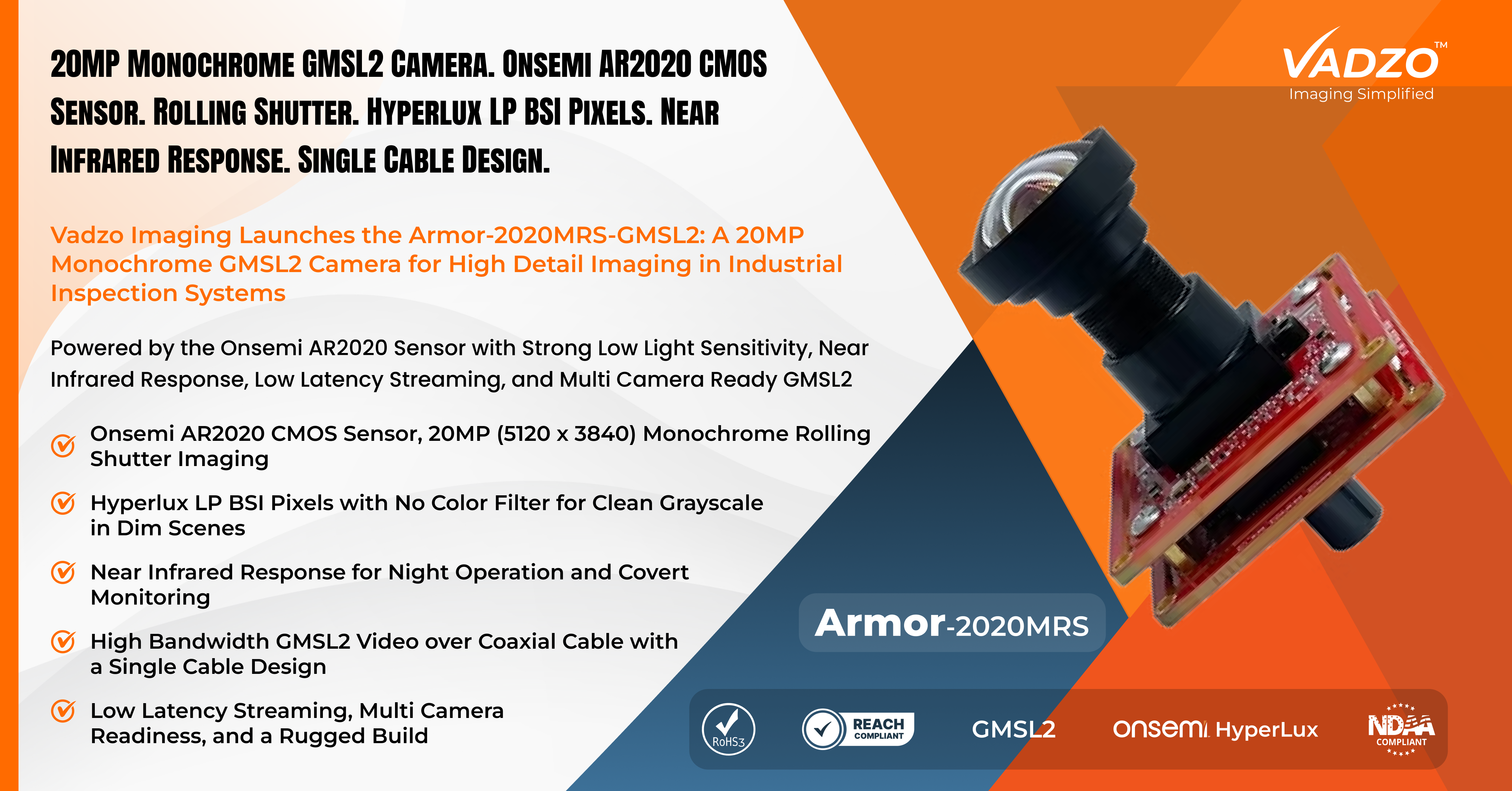
Product Overview: 20MP Monochrome GMSL2 Camera for Industrial Inspection Systems
The Armor-2020MRS-GMSL2 is a 20MP monochrome GMSL2 module built on the Onsemi AR2020 sensor. As a 5K Monochrome GMSL2 Camera, it records the full 5120 x 3840 frame, and as a 20MP Mono HDR GMSL2 Camera, it holds bright and dark regions together. The 5K Rolling Shutter GMSL2 Camera designation covers its readout. The module also serves as an AR2020 Mono GMSL2 Camera, a 4K Monochrome GMSL2 Camera, a 4K Mono HDR GMSL2 Camera, a 5K Mono HDR GMSL2 Camera, an AR2020 Mono HDR GMSL2 Camera, a 20MP 4K GMSL2 Camera, an AR2020 5K GMSL2 Camera, and a 20MP Mono GMSL2 Camera Module for designs that need a long, robust link.
Key Capabilities of the 20MP Monochrome GMSL2 Camera
Key specs: 20MP (5120 x 3840) Max Resolution | Onsemi AR2020 1/1.8 inch Sensor Format | 1.4 micron Pixel | Monochrome with Rolling Shutter | GMSL2 SerDes Interface | Lens per Module Configuration
20MP Monochrome Resolution
The sensor resolves fine features at 5120 x 3840 for measurement, defect detection, and character reading. In the illustrative example, a defect 0.1 millimeters wide spans about 3.4 pixels across a 150-millimeter field. A lens that resolves detail at the 1.4-micron pixel scale is needed to use the full frame, and teams should test the lens together with the camera.
Low Light Sensitivity
Hyperlux LP back-illuminated pixels with no color filter deliver clean grayscale images in dim scenes, since more light reaches each pixel and no interpolation adds noise. The pixels are small, so a lens with a wide aperture and steady illumination helps considerably. Where light can be added safely, a modest increase usually improves the image more than any setting.
Near Infrared Response
The sensor captures usable images under infrared illumination for night operation and covert monitoring, and it responds across the 850nm and 940nm bands that most illuminators use. An 850nm source gives a stronger signal with a faint red glow, and a 940nm source is invisible and weaker. Illuminators have limited reach, so range should be tested.
High-Bandwidth, Long-Reach Connectivity
GMSL2 transfers high-speed video over coaxial cable across long distances between the module and the host, with a nominal forward rate of up to 6 gigabits per second. A full frame at 8 bits per pixel and 30 frames per second needs about 4.7 gigabits per second, which fits. Teams should confirm the output format, the frame rate, and the cable length for their design.
Single-Cable Design
Video, control data, and power share one cable, which reduces wiring effort and installation time. A long cable drops voltage as current flows, so the power budget should be checked for the real run. As a 20MP Monochrome GMSL2 Camera Supplier and an AR2020 Mono GMSL2 Camera Supplier, Vadzo supports deserializer selection, cable planning, and enclosure design.
Low-Latency Streaming
Direct SerDes transfer keeps the delay added by the link minimal, which suits real-time decisions on moving platforms. The sensor readout and the host processing usually add more, so the whole chain should be measured, for example by filming a running timer on a display.
Multi Camera Readiness
The module works with multi-port GMSL2 deserializers for synchronized multi-camera setups, so several stations can capture at the same moment. The total bandwidth must fit the inputs of the host, and teams should plan it before choosing the number of units.
Rugged Design for Demanding Environments
The module is designed to withstand vibration and demanding environments in industrial and outdoor use. Teams should confirm the environmental ratings, secure the connector against vibration, and test the module on the real line.
“Inspection customers ask three questions about a camera. Can it see the defect, can it keep up with the line, and can it reach the computer? The Armor-2020MRS-GMSL2 answers the first with 20MP of monochrome detail, the third with one cable that carries video, control, and power, and it helps with the second because a monochrome frame fits one link at 30 frames per second. We are plain about the limits. A rolling shutter needs strobe lighting on a fast line; long cables drop voltage, and the details should be confirmed in the documentation. We help customers plan the lens, the lighting, and the link.” – Alwin Vincent, Product Manager, Vadzo Imaging.
Inspection and Monitoring Applications for 20MP Monochrome GMSL2 Camera
Industrial Inspection and Factory Automation
Production lines need camera units that see small features at speed. The Armor-2020MRS-GMSL2 works as an Industrial Inspection GMSL2 Camera and an Industrial Inspection Systems GMSL2 Camera on lines and cells, and as a Defect Detection GMSL2 Camera when it is paired with strobe lighting that freezes the part.
Measurement, barcode reading, and optical character reading on production lines benefit from clean grayscale frames. As a High Detail Inspection GMSL2 Camera, the module resolves defects across a 150-millimeter field in the illustrative example, and as a Quality Inspection GMSL2 Camera, it reads printed characters and bars with many pixels to spare. Teams should calibrate the lens, since a good lens at the pixel scale matters as much as the sensor.
Mobile Robots and Unmanned Vehicles
Autonomous mobile robots, drones, and unmanned ground vehicles carry camera units on moving parts, far from their compute modules, and a thin coaxial cable with video, control, and power suits them. Fast motion can skew a rolling shutter frame, so a short exposure and a damped mount help. Teams should check weight and connector retention.
Surveillance and Perimeter Security
Monitoring systems use infrared illumination at night, and the near-infrared response of this module suits it. It serves smart surveillance and perimeter security systems where one cable carries power and data to a pole or a fence. Privacy rules apply to recorded video and belong to the operator.
Frequently Asked Questions
Q: Does a monochrome camera need less bandwidth than a color camera on a serial link?
A: Vadzo Imaging explains that it usually does, because a monochrome frame carries one value per pixel. For example, a 20MP frame at 8 bits per pixel and 30 frames per second needs about 4.7 gigabits per second, which fits within the nominal 6 gigabits per second of one GMSL2 link, while a 12-bit color frame at the same rate needs about 7.1 gigabits per second. These figures are illustrative, and Vadzo Imaging recommends confirming the available modes.
Q: How many pixels does a defect or a character need?
A: Most software needs a few pixels across a defect and a few dozen across a character. For example, with a field 150 millimeters wide across 5120 pixels, each pixel covers about 29 microns, so a 0.1 millimeter defect spans about 3.4 pixels and a 1.5 millimeter character about 51. Vadzo Imaging recommends calculating the pixel size for the real lens and testing with real defects.
Q: Why do fast inspection lines use strobe lighting?
A: A part that moves during the exposure smears across pixels. For example, at 0.5 meters per second, a 1 millisecond exposure moves the part about 0.5 millimeters, which is about 17 pixels at 29 microns per pixel. A strobe that lights the part for tens of microseconds freezes it, and it avoids the skew that a rolling shutter can show. Vadzo Imaging suggests testing the timing on the real line.
Q: How should a team choose between full resolution and a 4K mode?
A: Full resolution gives the most detail and the largest stream, and a 4K mode gives a lighter stream and a higher frame rate. A team should start from the smallest feature it must resolve and the speed of the line, choose the mode that meets both, and confirm that the link and the host can carry it. Vadzo Imaging can help calculate the pixel size and the data rate for a given design.
Q: Why should integrators choose Vadzo Imaging as their 20MP monochrome GMSL2 camera supplier?
A: Vadzo Imaging offers more than a camera module built around a capable sensor. Integrators receive a 20MP monochrome module with a single-cable design, low-latency streaming, and multi-camera readiness, with candid guidance on lighting, bandwidth, and the details to confirm in the documentation, plus engineering support for lens selection, firmware customization, and enclosure design. Vadzo Imaging maintains evaluation kits with no minimum order requirement, so teams can test on their own line before committing to volume production.
Availability
The Armor-2020MRS-GMSL2 20MP Monochrome GMSL2 Camera, built on the Onsemi AR2020 sensor, is available now for evaluation and production orders. Evaluation kits include the camera module, a cable, and platform documentation, with no minimum order requirement. Integration teams can test defects with their own lens and strobe, measure voltage drop on their own cable, and check multi-camera synchronization across their own stations before committing to a production bill of materials. Browse the full range of camera options at Vadzo’s website or discuss OEM integration requirements.
About Vadzo Imaging
Vadzo Imaging is a global provider of embedded vision solutions and delivers high-performance camera technologies and imaging platforms for applications in robotics, industrial automation, UAVs, edge AI, and medical systems. Its products are designed for seamless integration with leading embedded platforms, including NVIDIA Jetson, Rockchip, Raspberry Pi, and NXP i.MX. Vadzo supports customers through hardware customization, firmware development, and module-level drivers, enabling faster development and deployment of vision based systems across MIPI, USB, GigE, Wi-Fi, GMSL2, and SerDes camera interfaces.
Media Contact
Alwin Vincent
Vadzo Imaging
Email: alwin@vadzoimaging.com
LinkedIn: Vadzo Imaging
YouTube: Vadzo Imaging
X: Vadzo Imaging
SOURCE: Vadzo Imaging
View the original press release on ACCESS Newswire
Media gallery
