
Sourdough Market Growth Driven by Fermentation Trends to Reach USD 6.67 Billion by 2035 at 6.8% CAGR
Sourdough market is expanding as consumers and bakeries favor fermentation, clean-label formulations, premium breads,
Press Release Disclaimer: This is a press release distributed through the XPR Media network. It has not been independently verified by our newsroom.
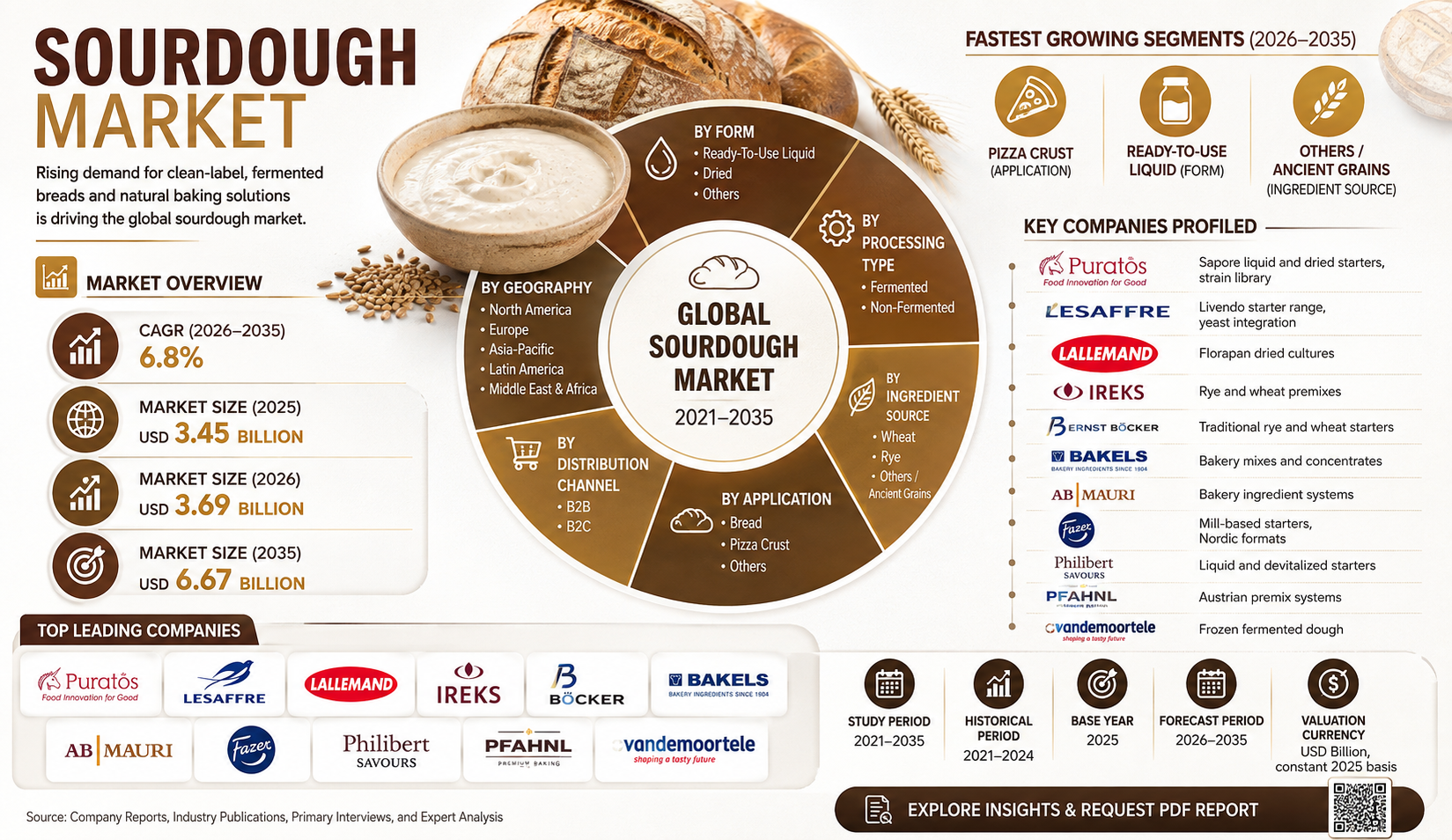

Sourdough market is expanding as consumers and bakeries favor fermentation, clean-label formulations, premium breads, and convenient ready-to-use cultures.
NEW YORK, NY, UNITED STATES, August 26, 2026 /EINPresswire.com/ —
The global Sourdough Market is entering a sustained growth phase as fermentation-based bakery products gain relevance across artisan, industrial, foodservice, and retail channels. Valued at USD 3.45 billion in 2025, the market is projected to reach USD 6.67 billion by 2035, expanding at a 6.8% CAGR from 2026 to 2035. The market is estimated at USD 3.69 billion in 2026, reflecting continued demand for products that combine traditional fermentation characteristics with modern convenience and scalable production.
Sourdough has moved beyond its traditional association with artisan bread. Commercial bakeries increasingly use sourdough starters, fermented dough systems, dried cultures, liquid preparations, and concentrates to improve flavor, dough performance, texture, and product differentiation. At the same time, consumer interest in naturally fermented foods, recognizable ingredients, premium bakery products, and diverse grain varieties is supporting market expansion. Competitive activity includes specialized culture producers, bakery ingredient suppliers, premix manufacturers, and vertically integrated food companies.
The competitive landscape is led by established ingredient and fermentation specialists. Puratos Group maintains a strong position through its Sapore liquid and dried starters and extensive strain library, while Lesaffre leverages fermentation science and its Livendo starter range. Lallemand Inc. focuses on dried cultures through Florapan, strengthening its position as a B2B culture specialist. IREKS GmbH and Ernst Böcker GmbH & Co. KG have strong expertise in rye and traditional starter systems. Other important participants include Bakels Worldwide, AB Mauri, Fazer Group, Philibert Savours, Pfahnl Backmittel GmbH, and Vandemoortele, creating a diversified competitive environment across geographic and application segments.
“Free Sample Copy” – Access A Complimentary Copy of Our Report to Explore Its Content and Insights
https://www.marketresearchfuture.com/sample_request/1823
Market Segmentation by Form
The sourdough market can be segmented into liquid, dried, and other forms, with ready-to-use liquid sourdough representing one of the fastest-growing areas. Liquid starters can simplify dosing and integration into industrial bakery processes while retaining fermentation characteristics. Their convenience makes them particularly relevant for commercial bakeries seeking consistent product quality.
Dried sourdough cultures offer longer shelf stability, easier transportation, and storage advantages. They are suitable for manufacturers operating across multiple production locations and for applications where standardized ingredient handling is important. Other formats, including concentrates and specialized preparations, address specific formulation and processing requirements.
Processing Type
By processing type, the market encompasses traditional fermentation, controlled fermentation, and industrial fermentation systems. Traditional fermentation remains closely associated with artisan baking, where long fermentation periods and starter management contribute to distinctive flavor and texture.
Controlled fermentation is increasingly important for commercial producers because it provides greater consistency in acidity, aroma, dough development, and production timing. Industrial fermentation systems allow manufacturers to incorporate sourdough characteristics into large-scale operations while maintaining standardized output. Advances in culture selection and fermentation management are therefore helping narrow the gap between artisan-style characteristics and industrial production efficiency.
Key Segments Driving Market Expansion
Ingredient Source
Ingredient sources include wheat, rye, and others/ancient grains. Wheat remains an important foundation because of its widespread use in bread, rolls, pizza products, and other bakery applications. Rye sourdough has particular importance in European baking traditions and is valued for its contribution to flavor, acidity, crumb structure, and grain-specific characteristics.
The others/ancient grains category is expected to experience strong growth as manufacturers experiment with grains such as spelt and other heritage varieties. This segment aligns with consumer interest in grain diversity, premium bakery positioning, and differentiated formulations.
Application
Applications span bread and rolls, pizza crust, cakes and pastries, crackers and snacks, and other bakery products. Bread and rolls remain a core application because sourdough fermentation naturally complements a broad range of bread formats.
Pizza crust is among the fastest-growing applications, supported by increasing interest in fermented crusts with distinctive flavor, texture, and extended fermentation characteristics. Sourdough is also being incorporated into crackers, snacks, pastries, and other products where manufacturers seek new sensory profiles and premium differentiation.
Distribution Channel
Distribution is divided between direct/B2B channels, retail, foodservice, and other channels. B2B distribution remains central because ingredient manufacturers primarily supply commercial bakeries, food manufacturers, and foodservice operators.
Retail distribution is becoming increasingly relevant as packaged sourdough bread, baking mixes, starter cultures, and home-baking products gain visibility. Foodservice operators, including restaurants, cafés, and specialty bakeries, also contribute to demand by incorporating fermented products into menus.
Geography
Geographically, the market covers North America, Europe, Asia-Pacific, Latin America, and the Middle East & Africa. Europe remains an important region because of its established bread culture, strong rye-baking traditions, artisan bakery infrastructure, and presence of major fermentation technology providers.
North America represents another significant market, supported by growing consumer awareness of sourdough and expansion of premium bakery offerings. Asia-Pacific is positioned for considerable long-term opportunity as urbanization, bakery consumption, foodservice development, and exposure to Western-style fermented bakery products increase. Latin America and the Middle East & Africa offer emerging opportunities as modern bakery formats and premium ingredients expand.
Industry Developments
1. Expansion of ready-to-use fermentation systems: Bakery ingredient suppliers are increasingly developing liquid, dried, and concentrated sourdough systems designed to reduce starter-management complexity. These solutions allow industrial and mid-sized bakeries to introduce fermentation characteristics with greater consistency and operational convenience.
2. Greater use of diverse grains and tailored cultures: Product development is increasingly moving toward ancient grains, rye varieties, and application-specific fermentation cultures. Manufacturers are exploring customized starter combinations to achieve differentiated acidity, aroma, texture, and processing performance across bread, pizza, snacks, and specialty bakery products.
Market Outlook
The outlook for the sourdough market remains positive through 2035. The combination of fermentation-based product development, clean-label preferences, premium bakery consumption, convenience-oriented starter formats, and innovation in grain sources is expected to sustain demand. The market’s progression from a predominantly artisan technique toward a commercially scalable ingredient platform is particularly significant.
Ready-to-use liquid formats, pizza crust applications, and ancient or alternative grains are expected to provide notable opportunities. Meanwhile, suppliers with fermentation expertise, extensive culture libraries, application laboratories, and broad geographic distribution are likely to remain well positioned as bakeries seek consistency without losing the sensory qualities associated with sourdough.
“Proceed To Buy” – Move Forward with Your Purchase and Gain Instant Access to the Complete Report
https://www.marketresearchfuture.com/checkout?currency=one_user-USD&report_id=1823
Competitive Landscape and Key Players
The competitive environment remains fragmented across global fermentation specialists, bakery ingredient companies, premix suppliers, and regional sourdough experts. Puratos Group, Lesaffre, Lallemand Inc., IREKS GmbH, Ernst Böcker GmbH & Co. KG, Bakels Worldwide, AB Mauri, Fazer Group, Philibert Savours, Pfahnl Backmittel GmbH, and Vandemoortele represent the leading companies profiled in the market.
Their strategies differ according to specialization. Some emphasize fermentation science and proprietary cultures, while others focus on bakery mixes, frozen dough, regional grain expertise, or integrated ingredient systems. This creates competition based not only on scale but also on culture performance, application support, formulation flexibility, geographic reach, and the ability to provide consistent sourdough characteristics at commercial volumes.
Frequently Asked Questions
1. What is driving the growth of the sourdough market?
Key growth drivers include increasing interest in fermented foods, premium bakery products, clean-label formulations, artisan-style bread, ready-to-use sourdough systems, and innovation in grain varieties.
2. Which sourdough market segment is expected to grow fastest?
Among the identified segments, pizza crust by application, ready-to-use liquid by form, and others/ancient grains by ingredient source are expected to demonstrate strong growth through the forecast period.
Conclusion
The global sourdough market is transitioning into a broader, technology-supported bakery ingredient category while retaining its connection with traditional fermentation. With the market projected to increase from USD 3.45 billion in 2025 to USD 6.67 billion by 2035 at a 6.8% CAGR, opportunities are emerging across cultures, starter formats, grains, bakery applications, and distribution models. Continued innovation in fermentation systems and the growing commercialization of sourdough are expected to shape the competitive landscape throughout the forecast period.
Read Our Related Research Report
Bread Crumb Market –
https://www.marketresearchfuture.com/reports/bread-crumb-market-28239
Bread Improver Market –
https://www.marketresearchfuture.com/reports/bread-improver-market-22585
Bread Processing Equipment Market –
https://www.marketresearchfuture.com/reports/bread-processing-equipment-market-38142
Baking Enzymes in Bread Application Market –
https://www.marketresearchfuture.com/reports/baking-enzymes-in-bread-application-market-22952
Batter And Breader Premixes Market –
https://www.marketresearchfuture.com/reports/batter-and-breader-premixes-market-23173
Sagar Kadam
Market Research Future
+1 628-258-0071
email us here
Legal Disclaimer:
EIN Presswire provides this news content “as is” without warranty of any kind. We do not accept any responsibility or liability
for the accuracy, content, images, videos, licenses, completeness, legality, or reliability of the information contained in this
article. If you have any complaints or copyright issues related to this article, kindly contact the author above.

Media gallery


